
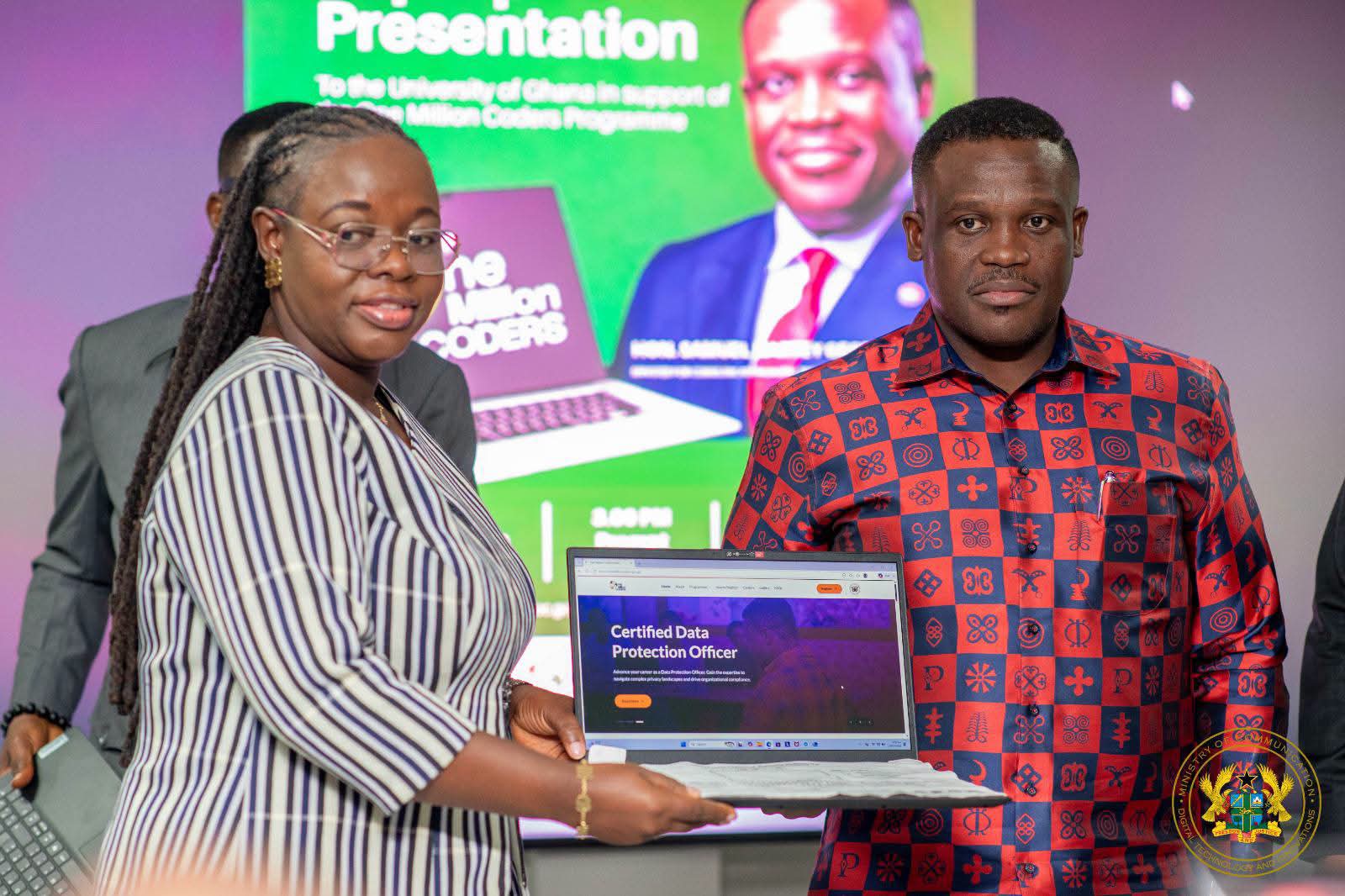
The Minister for Communication, Digital Technology and Innovations, Hon. Samuel Nartey George, has officially handed over 2,000 laptops to the University of Ghana in support of the Government’s flagship One Million Coders Programme (OMCP).
The presentation follows an earlier donation of 500 laptops and forms part of the Government’s commitment to equipping young Ghanaians with digital and artificial intelligence (AI) skills needed to compete in the global technology-driven economy.
Speaking at the ceremony, Hon. Samuel Nartey George described the One Million Coders Programme as a key national initiative aimed at training one million Ghanaians in coding, software development, artificial intelligence, cybersecurity, data analytics, and other emerging technologies. He said the programme is designed to improve employability, promote innovation, and prepare the country’s youth for the future of work.
The Minister praised the University of Ghana for permanently integrating the One Million Coders Programme into its academic curriculum, describing the move as a bold step that will ensure digital skills and AI literacy become a core part of students’ education across all disciplines.
He stressed that AI and digital skills are no longer limited to computer science but are becoming essential for professionals in every field, including healthcare, business, education, public service, and entrepreneurship.
Hon. Samuel Nartey George also announced that the Government will continue to strengthen its partnership with the University by expanding access to laptops, improving connectivity, and supporting the training of lecturers in AI-driven teaching and curriculum development.
He further appealed to technology companies, telecom operators, financial institutions, and corporate organisations to support the initiative through internships, mentorship programmes, scholarships, equipment donations, and employment opportunities for participants.
The Minister acknowledged the contributions of Google, MTN, Telecel, and Huawei for supporting the One Million Coders Programme and reiterated the Government’s commitment to building a digitally skilled workforce capable of driving innovation, economic growth, and national development.
The 2,000 laptops are expected to enhance practical learning, coding, research, innovation, and problem-solving among students, helping position Ghana as a competitive player in the global digital economy.